Thailand

By Josh Pearson , 7 May 2026

Thailand’s casino landscape in 2026 remains defined by strict prohibition, limited legal gambling channels, and ongoing political debate over potential legalization. Under the Gambling Act of 1935, most forms of gambling—including casinos and sports betting—remain illegal, with only state-run lotteries and licensed horse racing permitted. Despite this, underground gambling activity and offshore online platforms continue to attract participation, reflecting strong domestic demand.
By Josh Pearson , 22 March 2026

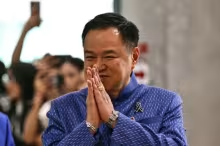
Thailand’s political transition has delivered a decisive blow to plans for a regulated casino industry, signaling a shift in economic priorities and investor sentiment. The return of Prime Minister Anutin Charnvirakul, following a decisive electoral mandate, has effectively halted the proposed Integrated Entertainment Business Act. This legislation had aimed to legalize casino operations and position Thailand as a regional gaming hub. Its suspension not only impacts projected tourism inflows and foreign investment but also reshapes Southeast Asia’s competitive gaming landscape.

By Josh Pearson , 13 March 2026

Thailand is increasingly exploring the legalization of casino gambling as policymakers examine new ways to strengthen tourism, attract foreign investment and generate government revenue. While gambling remains largely restricted in the country, ongoing discussions around integrated entertainment complexes suggest a potential shift in policy. Supporters argue that regulated casino resorts could boost economic growth, create jobs and increase tax income. Critics, however, warn about social risks and regulatory challenges.

By Josh Pearson , 1 March 2026

Thailand’s government has outlined plans for a transformative tourism and entertainment complex in the Eastern Economic Corridor, a flagship economic zone that includes Pattaya, located southeast of Bangkok. With a projected investment of Bt700 billion, equivalent to approximately US$22.56 billion or nearly Rs. 1.87 lakh crore, the initiative represents one of the most ambitious infrastructure and leisure developments in the country’s modern history.

By Josh Pearson , 27 February 2026

Thailand is advancing a high-stakes tourism strategy within its Eastern Economic Corridor, deliberately excluding casino development from its blueprint for growth. Policymakers are positioning the corridor as a magnet for high-value industries, sustainable travel and family-oriented leisure, resisting calls to introduce integrated gaming resorts as a revenue catalyst. The move underscores Bangkok’s preference for long-term economic resilience over short-term fiscal windfalls.

By Josh Pearson , 20 January 2026

Thailand’s Pheu Thai Party has softened its earlier stance on legalising casinos, stepping back from an ambitious proposal as national elections approach. The policy rethink reflects rising public sensitivity around social risks, regulatory readiness, and political consensus rather than a wholesale rejection of gaming reform. While casino development was once positioned as a potential driver of tourism investment and fiscal revenue, party leaders now signal caution, prioritising stability and broader voter concerns.

By Josh Pearson , 27 December 2025

Thailand’s long-discussed plans to legalize and develop casino-based entertainment complexes have been placed on hold as political uncertainty clouds the policy landscape. Lawmakers and regulators are reassessing the timing and feasibility of moving forward amid shifting coalition dynamics and heightened public debate. The pause reflects concerns over governance stability, regulatory readiness, and social impact rather than a rejection of the underlying economic rationale.

By Josh Pearson , 22 December 2025

Tensions between Thailand and Cambodia escalated sharply after a Thai military strike targeted a casino complex near the shared border, intensifying regional concern and prompting urgent diplomatic engagement. The incident underscores fragile security dynamics along the frontier, where illicit activity, cross-border crime, and competing jurisdictional claims have long tested bilateral relations. While both governments signaled a desire to avoid broader conflict, the episode has drawn the Association of Southeast Asian Nations into a mediating role.

By Josh Pearson , 20 December 2025

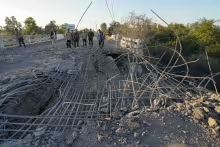
Explosions reported near Thailand’s border with Cambodia, close to the busy Poipet crossing, have heightened security concerns in one of Southeast Asia’s most commercially active frontier zones. The incident, which occurred in proximity to a key transit and trading corridor, prompted swift responses from local authorities and border security forces. While details surrounding responsibility and motive remain under investigation, the blasts underscore persistent vulnerabilities along regional border areas that combine heavy cross-border movement with complex geopolitical sensitivities.