Gambling encompasses a wide range of games and activities where participants stake money on uncertain outcomes in the hope of earning a profit. From traditional casino table games and slot machines to sports betting and online platforms, the industry blends entertainment with financial risk. Outcomes are determined by chance, skill, or a combination of both, depending on the format. While some players experience short-term gains, the mathematical structure of most games ensures that operators maintain a long-term advantage. Understanding how different gambling activities function can help individuals make informed decisions about risk, probability, and responsible participation.
Major Categories of Gambling Activities
Casino Table Games
These include blackjack, roulette, baccarat, and poker variants offered in land-based and online casinos. Each game has distinct rules and odds. Some, like blackjack and poker, involve elements of skill and strategy, while others rely predominantly on random outcomes.
Slot Machines and Electronic Games
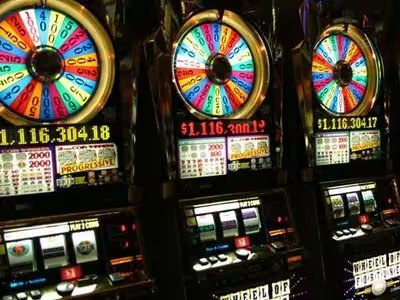
Slot machines are among the most popular gambling formats globally. Results are determined by random number generators, ensuring unpredictability. Payout percentages are programmed into the machines, meaning that over time, total payouts are lower than total wagers.
Sports and Event Betting
Sports betting involves wagering on the outcome of athletic events, political races, or entertainment competitions. Odds are set by bookmakers based on probability assessments, and payouts depend on both the stake and the odds at the time of the bet.
Lottery and Draw-Based Games
Lotteries require players to select number combinations, with winners chosen through random draws. These games typically offer large jackpots but have extremely low probabilities of winning top prizes.
Online Gambling Platforms
Digital platforms combine multiple game formats, including virtual casinos, live dealer games, and esports betting. Online access has expanded global participation while raising regulatory and responsible gaming considerations.
How People Win Money
Winning in gambling occurs when the outcome of a wager aligns with the player’s prediction or when a random result favors the bettor. In games involving skill, such as poker, experienced players may gain an advantage through strategy, probability assessment, and psychological insight. In sports betting, knowledge of teams, statistics, and conditions can influence decision-making.
However, even in skill-based contexts, uncertainty remains a central factor. Short-term wins are possible, and some players experience occasional large payouts, especially in jackpot-based games.
How People Lose Money
Losses occur when outcomes do not favor the bettor, which statistically happens more often over time. Most gambling games are structured with a “house edge,” meaning the operator retains a small percentage of each wager on average. This mathematical advantage ensures long-term profitability for casinos and betting providers.
Frequent play, chasing losses, and overestimating skill can amplify financial losses. Randomness also means that even informed decisions cannot eliminate risk entirely.
The Role of Probability and Risk
Probability governs all gambling outcomes. Games of pure chance rely entirely on random processes, while skill-based games incorporate decision-making within probabilistic frameworks. Understanding odds, payout structures, and variance can help individuals better assess potential outcomes.
Importantly, no strategy can guarantee consistent profits in games designed with a built-in house advantage. Responsible participation requires recognizing gambling as a form of entertainment rather than a reliable income source.
Conclusion
Gambling spans diverse activities, each with unique mechanics and levels of risk. While winning is possible, the structural design of most games favors operators over the long term. Awareness of how different formats work — including the roles of chance, skill, and probability — can help individuals approach gambling with realistic expectations and informed judgment.
Comments