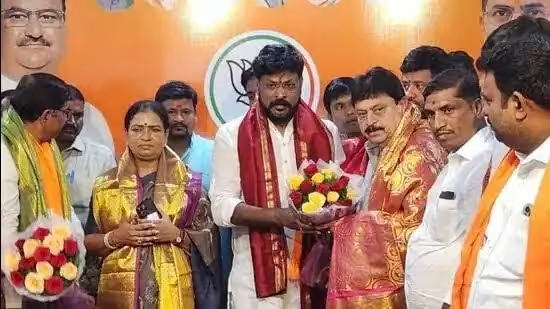
The appointment of Praveen Kumar Chikoti as a spokesperson for the Bharatiya Janata Party in Telangana has generated significant political discussion. The decision, announced by state party president N. Ramchander Rao, assigns Chikoti responsibility for representing the party in areas including Bhagyanagar and Malakpet. However, the move has drawn attention due to past allegations connecting Chikoti to casino-related activities. While he has previously acknowledged international contacts within the gaming industry, his new political role raises broader questions about reputational risk, regulatory oversight and the evolving relationship between business networks and regional political structures.
BJP Announces New Organizational Appointments in Telangana
The Bharatiya Janata Party has unveiled a fresh round of organizational appointments in Telangana, aiming to strengthen its communication strategy and regional political presence.
The announcement was made by state party president N. Ramchander Rao, who outlined several structural changes within the party’s state unit. Among the most notable appointments was the naming of Praveen Kumar Chikoti as an official spokesperson.
Under the new role, Chikoti will be responsible for representing the party in public communications and media interactions in areas including Bhagyanagar and Malakpet, both politically active constituencies in the state’s capital region.
Party officials have framed the appointments as part of a broader strategy to expand outreach, strengthen messaging and enhance the party’s visibility across urban and semi-urban areas.
Controversy Surrounding the Appointment
Despite the party’s organizational rationale, Chikoti’s appointment has triggered debate within political circles due to controversies associated with his past activities.
Praveen Kumar Chikoti has previously faced allegations related to organizing casino-style gaming events. Critics and rival political groups have pointed to earlier complaints claiming that large-scale gambling operations were conducted during festive seasons.
These allegations reportedly led to scrutiny from law enforcement authorities in the past. Investigative agencies are said to have issued notices as part of inquiries into the activities, although the legal outcomes of those probes have not resulted in widely publicized convictions.
Chikoti himself has previously acknowledged maintaining contacts with casino operators in foreign jurisdictions, a statement that further fueled speculation about his involvement in the gaming sector.
Intersection of Business Networks and Political Influence
The controversy surrounding this appointment also reflects a broader dynamic in regional politics: the growing intersection between business interests and political influence.
Individuals with entrepreneurial backgrounds increasingly play roles within political organizations, particularly in areas such as fundraising, campaign management and public outreach. In many cases, these networks can provide parties with access to resources, local connections and strategic communication capabilities.
However, analysts note that such appointments can also carry reputational risks if individuals involved have previously been linked to controversial industries or unresolved allegations.
For political parties operating in competitive electoral environments, balancing the benefits of influential networks with public perception becomes a delicate task.
Role and Responsibilities of Party Spokespersons
As a spokesperson for the Bharatiya Janata Party in Telangana, Chikoti will likely serve as a public representative of the party’s positions on political and governance issues.
Spokespersons typically engage with media outlets, participate in debates and communicate official party viewpoints on policy matters. They also play a crucial role in shaping the narrative during politically sensitive moments, including elections, policy announcements and political controversies.
Given this public-facing responsibility, the selection of spokespersons often attracts scrutiny, as their background and credibility can directly influence how the party’s messaging is perceived.
Political Reactions and Public Discussion
The decision to appoint Praveen Kumar Chikoti has quickly become a topic of conversation among political observers in Telangana.
Opposition groups and commentators have raised questions about the implications of selecting an individual associated with casino-related allegations for a prominent communication role within the party. Supporters, however, argue that organizational appointments should be evaluated on the basis of current contributions rather than past controversies that have not resulted in definitive legal findings.
Such debates are not uncommon in Indian politics, where appointments often become focal points for broader discussions about accountability, transparency and political strategy.
Broader Implications for Political Messaging
Beyond the immediate controversy, the episode highlights the evolving nature of political communication in India’s state-level politics.
As political parties compete to expand their influence across diverse voter groups, spokespersons increasingly serve as strategic intermediaries between party leadership, the media and the public. Their personal reputation and communication skills can significantly shape the effectiveness of political messaging.
For the Bharatiya Janata Party in Telangana, the appointment may represent an attempt to strengthen its presence in key constituencies while leveraging individuals with strong local networks.
Conclusion
The appointment of Praveen Kumar Chikoti as a spokesperson for the Bharatiya Janata Party in Telangana underscores the complex relationship between politics, public perception and business influence.
While the party leadership has positioned the decision as part of routine organizational restructuring under N. Ramchander Rao, the move has inevitably reignited discussion about past controversies linked to Chikoti.
As political debates continue, the development illustrates how leadership choices within political organizations can quickly evolve into broader conversations about transparency, credibility and the strategic direction of regional politics.
Comments