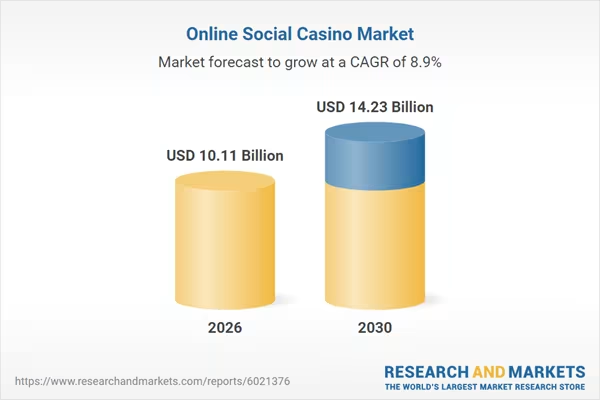
The global online social casino market is projected to reach $14.23 billion, driven by the convergence of immersive digital experiences, artificial intelligence-driven personalization and the rapid expansion of free-to-play gaming ecosystems. Industry forecasts spanning 2020-2025, 2025-2030 and extending toward 2035 indicate sustained momentum as operators refine cross-platform accessibility and deepen user engagement. Unlike real-money gambling platforms, social casinos monetize through virtual goods and in-app purchases, fostering scalable digital economies. As competition intensifies, strategic differentiation will hinge on technology integration, mobile optimization and community-based features that transform solitary play into shared entertainment experiences.
Market Overview and Forecast Outlook
The online social casino sector has evolved into one of the fastest-growing segments within interactive entertainment. Industry projections estimate the market will reach $14.23 billion in valuation, reflecting strong compound annual growth across forecast periods ending in 2025, 2030 and 2035.
Unlike regulated wagering platforms, social casinos operate on free-to-play models, generating revenue primarily through virtual currency purchases and in-game enhancements. This structural distinction broadens accessibility and reduces regulatory friction, enabling expansion across diverse jurisdictions.
Growth over the 2020-2025 period laid the foundation for scale, while forecasts for 2025-2030 anticipate accelerated innovation and user base diversification.
Immersive Social Gaming as a Core Growth Driver
One of the most significant market opportunities lies in immersive gaming environments. Advances in graphics rendering, augmented reality and real-time multiplayer functionality have reshaped user expectations. Players increasingly seek interactive, socially connected experiences rather than isolated gameplay.
Virtual lounges, competitive tournaments and avatar-based engagement ecosystems are redefining how users interact within digital casino environments. By replicating the ambiance of physical gaming spaces while enhancing social connectivity, operators can increase session duration and retention rates.
Immersion is no longer a differentiator — it is rapidly becoming an industry standard.
Artificial Intelligence and Personalization Strategies
Artificial intelligence has emerged as a pivotal force in user acquisition and retention. AI-driven analytics enable operators to tailor promotional offers, optimize in-game rewards and adjust difficulty levels based on behavioral data.
Personalization enhances lifetime customer value by aligning gameplay incentives with individual preferences. Predictive algorithms can identify churn risks, allowing platforms to intervene with targeted engagement strategies.
As competition intensifies, data-driven personalization will likely become the primary lever for sustaining revenue growth.
Rise of Virtual Economies and Monetization Models
The economic engine of social casinos is the virtual economy. Players purchase digital tokens, cosmetic upgrades and gameplay boosters, creating recurring revenue streams without traditional wagering.
The free-to-play model lowers entry barriers while encouraging microtransactions. Operators increasingly design layered reward systems that incentivize progression and social interaction, reinforcing long-term engagement.
The sustainability of this model depends on balancing monetization with user satisfaction. Excessive pay-to-progress structures risk eroding trust and reducing active user metrics.
Cross-Platform Expansion and Mobile Dominance
Mobile gaming continues to dominate digital entertainment consumption. Seamless integration across smartphones, tablets and desktop platforms has become essential for market competitiveness.
Cross-platform synchronization allows users to transition between devices without disrupting gameplay continuity. This flexibility increases daily active usage and expands demographic reach.
Emerging markets with high smartphone penetration present particularly strong growth prospects over the 2025-2030 forecast horizon.
Competitive Landscape and Strategic Differentiation
The competitive landscape is characterized by rapid innovation cycles and aggressive user acquisition strategies. Leading operators invest heavily in user interface design, social community features and influencer-driven marketing campaigns.
Strategic partnerships with technology providers and entertainment brands are becoming increasingly common. Such alliances can amplify brand visibility and introduce new revenue verticals.
However, scale alone does not guarantee resilience. Sustainable growth will require disciplined cost management, platform stability and continuous feature refinement.
Long-Term Outlook Through 2035
Forecasts extending to 2035 suggest structural maturation rather than explosive volatility. As the industry stabilizes, consolidation may increase, with larger platforms absorbing niche competitors to expand user ecosystems.
Regulatory developments related to digital consumer protection and data privacy could influence operational frameworks. Nonetheless, the underlying drivers — social connectivity, gamification and mobile ubiquity — remain durable.
The sector’s projected $14.23 billion valuation underscores its evolution from a niche entertainment category to a mainstream digital economy segment.
Conclusion
The online social casino market stands at the intersection of technology, entertainment and behavioral economics. Immersive gameplay, AI-enhanced personalization and scalable virtual economies are reshaping industry architecture.
As operators navigate competitive pressures and evolving consumer expectations, long-term success will depend on strategic agility and responsible innovation. With multi-year forecasts indicating sustained expansion, the sector appears positioned for durable growth through 2035.
Comments