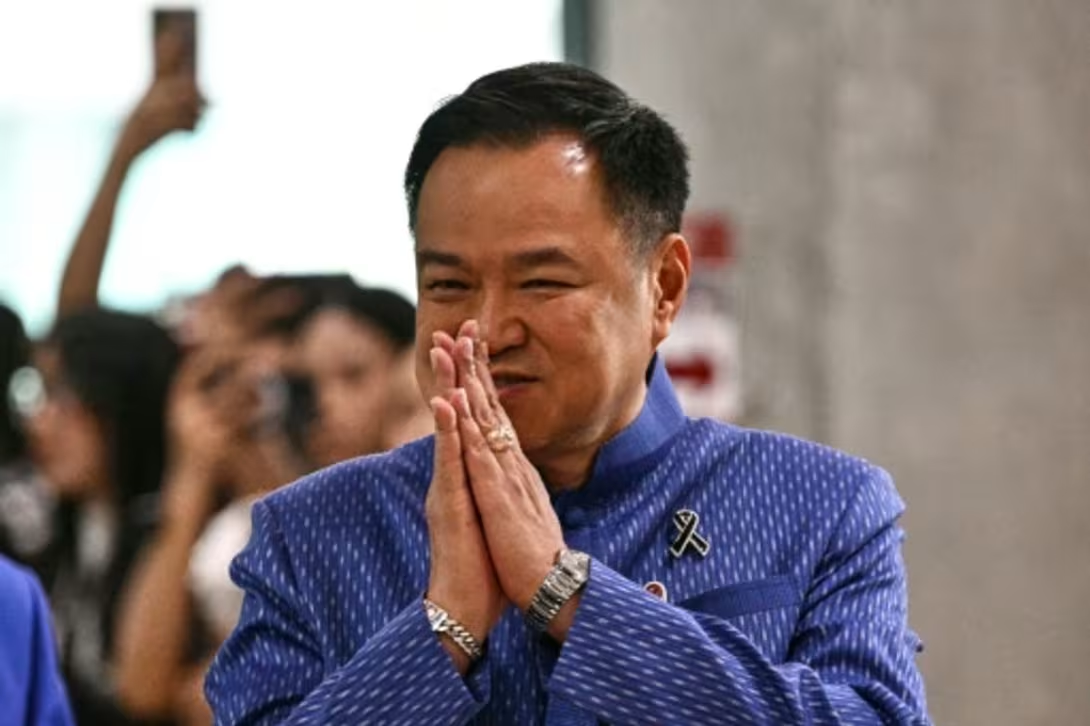
Thailand’s political transition has delivered a decisive blow to plans for a regulated casino industry, signaling a shift in economic priorities and investor sentiment. The return of Prime Minister Anutin Charnvirakul, following a decisive electoral mandate, has effectively halted the proposed Integrated Entertainment Business Act. This legislation had aimed to legalize casino operations and position Thailand as a regional gaming hub. Its suspension not only impacts projected tourism inflows and foreign investment but also reshapes Southeast Asia’s competitive gaming landscape. Analysts now expect a pause in large-scale integrated resort development, as policymakers reassess the balance between economic expansion and social considerations.
Political Shift Resets Thailand’s Casino Ambitions
Thailand’s ambitions to establish a legal casino sector have been abruptly curtailed following the reappointment of Anutin Charnvirakul as prime minister. His electoral victory, secured with a commanding majority in the national legislature, reflects a broader political recalibration that deprioritizes the rapid expansion of the gaming industry.
The now-stalled Integrated Entertainment Business Act had been central to Thailand’s strategy to attract global capital and diversify tourism revenues. Its suspension underscores how political leadership can significantly influence regulatory trajectories in emerging gaming markets.
Legislative Context and Policy Reversal
The casino legalization framework had been championed by former Prime Minister Paetongtarn Shinawatra, whose administration viewed integrated resorts as catalysts for economic modernization. However, her removal from office on ethics-related charges disrupted legislative continuity.
With Anutin’s return, the policy direction has shifted toward caution. The new administration appears less inclined to pursue aggressive liberalization, particularly in sectors that carry social and regulatory sensitivities. As a result, the legislative momentum behind casino legalization has effectively dissipated.
Economic Implications for Tourism and Investment
The suspension of casino legalization plans carries significant economic implications. Industry projections had positioned Thailand as a potential competitor to established gaming hubs such as Singapore and Macau, with expectations of substantial foreign direct investment and job creation.
Integrated resorts typically generate multi-layered economic benefits, including hospitality expansion, infrastructure development, and increased tourism spending. The halt in policy progress introduces uncertainty for international operators who had been evaluating market entry strategies.
From a capital markets perspective, the decision may delay billions in potential investment flows, while also redirecting investor attention toward more stable regulatory environments in Asia.
Regional Competitive Dynamics
Thailand’s withdrawal from the casino legalization race reshapes the competitive landscape in Southeast Asia. Markets with established regulatory frameworks are likely to consolidate their positions, benefiting from reduced competition for high-value gaming tourists.
At the same time, emerging jurisdictions seeking to liberalize their gaming sectors may view Thailand’s policy reversal as a cautionary example of political risk. Regulatory consistency remains a key determinant in attracting long-term investment in the gaming industry.
Balancing Growth and Social Policy
The debate surrounding casino legalization in Thailand has always extended beyond economics. Concerns related to social impact, regulatory oversight, and responsible gaming have played a central role in shaping public discourse.
The current administration’s stance suggests a preference for gradual, controlled development rather than rapid industry expansion. This approach reflects a broader trend among policymakers who seek to balance revenue generation with societal considerations.
Outlook: Strategic Pause or Long-Term Shift?
While the immediate outlook for Thailand’s casino industry appears constrained, the long-term trajectory remains uncertain. Political cycles, economic pressures, and regional competition could eventually revive discussions around legalization.
For now, however, the country’s gaming ambitions are on hold. Investors and industry stakeholders are likely to adopt a wait-and-watch approach, closely monitoring policy signals from the government.
In the evolving global gaming landscape, Thailand’s decision serves as a reminder that regulatory clarity and political stability are as critical as market potential in shaping the future of the industry.
Comments