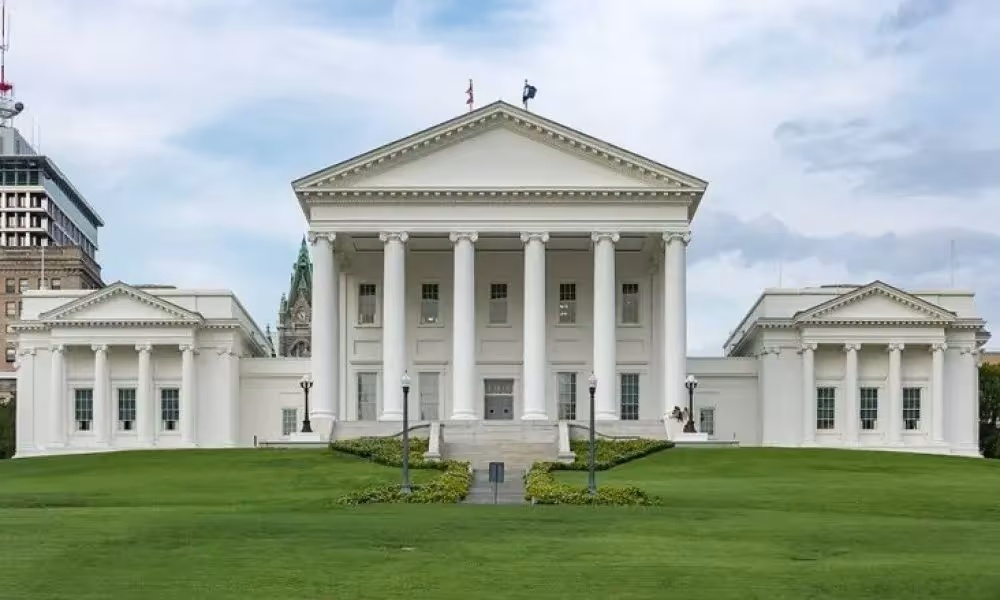
A proposal to authorize a casino in Fairfax County has advanced to the full floor of the Virginia House of Delegates after clearing committee review for the first time in three legislative attempts. The bill would permit a casino as part of a mixed-use entertainment development anywhere within the county’s jurisdiction. Proponents argue the project could generate substantial new tax revenue and employment opportunities, easing fiscal pressures in one of Virginia’s most economically significant regions. The measure, revived by Scott Surovell, now faces a decisive vote amid intensifying debate over economic impact and community implications.
Legislative Momentum After Prior Setbacks
The casino authorization bill has reached a critical stage following committee approval, marking a breakthrough after previous unsuccessful efforts. The legislation is scheduled for consideration by the full Virginia House of Delegates, where its fiscal and social implications are expected to draw rigorous scrutiny.
Supporters describe the advancement as a pivotal moment in Fairfax County’s broader economic strategy. Opponents, however, remain cautious, citing concerns over community impact and regulatory oversight.
The outcome of the forthcoming vote could significantly reshape the county’s revenue framework.
Framework of the Proposed Development
Under the bill’s provisions, a casino would be permitted anywhere within Fairfax County, provided it forms part of a larger mixed-use entertainment complex. Such developments typically integrate gaming operations with hotels, retail outlets, dining establishments and event spaces.
This integrated model aims to diversify revenue streams and attract both local patrons and out-of-state visitors. Mixed-use entertainment districts often generate extended visitor stays, increasing overall economic activity.
If approved, the project would require subsequent regulatory and zoning approvals before construction could begin.
Fiscal Pressures and Revenue Arguments
Advocates of the proposal emphasize Fairfax County’s fiscal challenges, including rising public service costs and pressure on property tax rates. According to Sen. Scott Surovell, the county’s real estate tax rate ranks among the highest in Virginia, excluding the independent city of Falls Church.
Casino-generated revenue could potentially supplement the county’s tax base through gaming taxes, business levies and ancillary economic growth. Proponents contend that diversifying revenue sources would reduce reliance on residential property taxes.
Employment generation during construction and long-term operations is also central to the economic case presented by supporters.
Economic Implications and Regional Competition
Virginia has gradually expanded legalized gaming in recent years, authorizing casinos in select cities to stimulate economic development. Fairfax County, as a densely populated and affluent jurisdiction within the Washington metropolitan area, represents a potentially lucrative market.
An approved casino could position the county competitively within the Mid-Atlantic gaming landscape, capturing entertainment spending that might otherwise flow to neighboring states.
However, market saturation risks and competition from existing regional casinos remain important considerations for policymakers.
Community and Regulatory Considerations
Beyond fiscal metrics, the proposal raises questions about traffic management, public safety resources and social impact mitigation. Effective regulation, transparency and community engagement would be essential components of any approved development.
Local leaders are expected to weigh projected revenue gains against potential long-term social costs. Public opinion within the county may also influence legislative dynamics.
Balancing economic ambition with responsible governance will be central to the debate.
Political Context and Outlook
The bill’s revival by Sen. Scott Surovell underscores ongoing legislative interest in expanding gaming as an economic development tool. Its progression out of committee for the first time signals shifting political momentum.
Should the Virginia House of Delegates approve the measure, subsequent legislative and regulatory steps would determine the pace and structure of implementation.
The forthcoming vote represents a decisive juncture in Fairfax County’s economic policy trajectory.
Conclusion
The proposed Fairfax County casino bill now stands before the Virginia House of Delegates after overcoming prior legislative hurdles. Framed as a mixed-use development initiative, the project promises potential tax diversification and job creation while raising legitimate community concerns.
As lawmakers prepare to cast their votes, the decision will likely shape the county’s fiscal strategy and regional economic positioning for years to come.
Comments