The prospect of a casino in northeast Indiana has resurfaced as a prominent economic and political issue, with state lawmakers advancing House Bill 1038 to the brink of a decisive Senate vote. The legislation could authorize the placement of a casino in the region, though not necessarily through relocation of an existing license. In Fort Wayne, Mayor Sharon Tucker has publicly addressed the opportunity, framing it as a potential driver of investment and job creation. Yet the proposal remains subject to amendments, including a possible referendum requirement.
Legislative Momentum Builds in Indianapolis
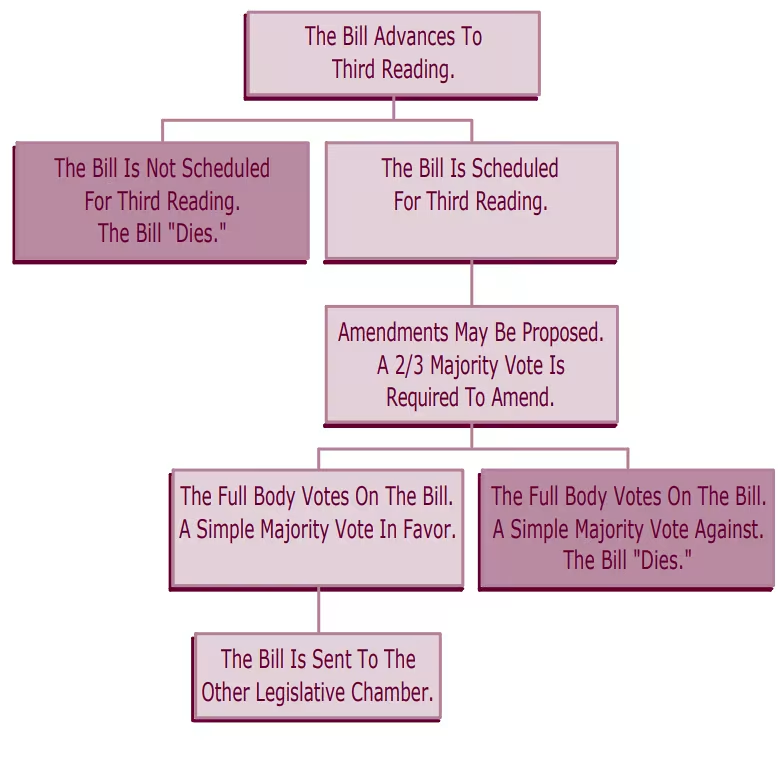
The debate over a casino in northeast Indiana has shifted from local speculation to formal legislative action. House Bill 1038, under consideration at the Statehouse in Indianapolis, cleared a significant procedural hurdle when the State Senate advanced a revised version of the measure.
Lawmakers incorporated an amendment clarifying that the bill would permit the establishment of a casino in the region without mandating the relocation of an existing gaming license. This distinction is consequential, as it broadens the structural possibilities for expansion while preserving flexibility in regulatory execution.
With the bill now scheduled for a full Senate vote, the coming days may determine whether northeast Indiana moves closer to joining the state’s regulated gaming landscape.
Fort Wayne’s Economic Calculus
In Fort Wayne, often referred to as the Summit City, the potential arrival of a casino has ignited renewed discussion about economic diversification. During her recent State of the City address, Mayor Sharon Tucker acknowledged the legislative developments, signaling that municipal leaders are closely monitoring the proposal.
Supporters argue that a casino could serve as a catalyst for regional development. Proponents cite job creation, increased tourism spending and ancillary growth in hospitality and retail sectors as potential benefits. In a competitive Midwestern market, advocates contend that strategic gaming expansion may strengthen the region’s fiscal base.
However, municipal endorsement alone cannot determine the outcome. Under Indiana law, gaming authorization ultimately rests with state lawmakers and regulatory bodies.
Policy Considerations and Possible Referendum
While HB 1038 has gained legislative traction, its final contours remain unsettled. Senators retain the ability to introduce additional amendments prior to the decisive vote. Among the proposals expected to surface is a referendum requirement that would allow local voters to weigh in on the matter.
A referendum provision would significantly alter the trajectory of the proposal, embedding direct democratic consent into the process. Such mechanisms have been used in other jurisdictions to legitimize gaming expansion and mitigate community opposition.
The inclusion—or exclusion—of this requirement may influence not only the bill’s passage but also its political durability.
Broader Implications for Indiana’s Gaming Market
Indiana’s gaming sector already contributes substantial tax revenues and employment across multiple regions. Expanding into the northeastern corridor would reshape competitive dynamics, potentially redistributing market share among existing operators.
Industry analysts note that careful regulatory planning would be essential to avoid market saturation. Factors such as proximity to neighboring states, population density and projected consumer demand will shape long-term viability.
Moreover, policymakers must weigh potential economic gains against social considerations, including infrastructure strain and responsible gaming safeguards.
A Defining Week Ahead
As the Senate prepares for its final vote, northeast Indiana stands at a crossroads. What began as a regional conversation has evolved into a statewide policy decision with lasting economic implications.
Whether HB 1038 ultimately authorizes a new casino, incorporates a referendum requirement or stalls in legislative deliberation, the debate underscores a broader theme: the intersection of economic ambition and public accountability.
For Fort Wayne and its surrounding communities, the outcome may define the next chapter of regional development strategy—one shaped as much by political consensus as by fiscal opportunity.
Comments