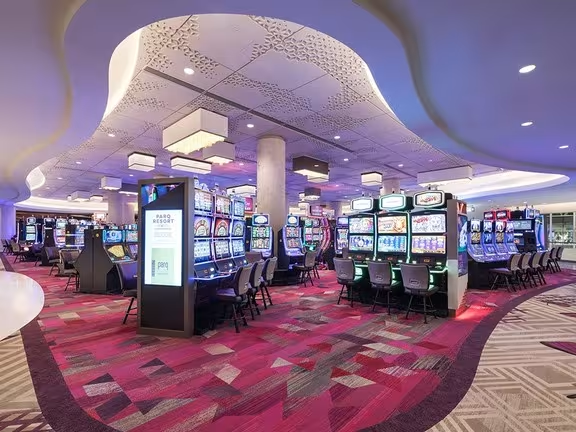
Parq Holdings has formally applied to increase the number of slot machines at its Vancouver casino from 600 to 900, a 50% expansion that could significantly enhance gaming revenue capacity. The proposal follows a 2024 decision by Vancouver city council to relax a long-standing moratorium on gambling expansion, provided applicants assess health, social and economic impacts. City staff have recommended that any approval be conditional upon strengthened measures to mitigate problem gambling harms. The decision now moves to a public hearing, placing economic opportunity and social responsibility at the center of municipal deliberations.
Expansion Proposal Signals Growth Ambitions
Parq Holdings, operator of the Parq casino complex adjacent to BC Place Stadium, has requested authorization to increase its slot machine inventory by 300 units. The proposal would expand the total number of machines from 600 to 900.
The property, integrated within a hotel and conference center in downtown Vancouver, is positioned as both an entertainment venue and hospitality hub. Expanding the slot floor by 50% would materially increase the casino’s revenue-generating capacity, particularly as slot machines typically account for the majority of gaming income in most regulated markets.
The request has been referred to a public hearing following preliminary council review.
Policy Shift Opens Door to Applications
The application follows a pivotal decision by Vancouver City Council in May 2024 to amend a 2011 moratorium on gambling expansion. The revision was made at the request of the British Columbia Lottery Corporation, which oversees gaming operations across the province.
Under the updated framework, council agreed to consider expansion proposals provided they include comprehensive assessments of health, social and economic impacts. The vote passed by a 5–3 margin, signaling a cautious but pragmatic shift in policy.
The moratorium had previously constrained the growth of gaming capacity within city limits, reflecting long-standing concerns over addiction, financial hardship and community well-being.
Economic Rationale Behind the Proposal
From a financial perspective, increasing slot capacity can yield predictable revenue growth. Slot machines operate with relatively low staffing requirements and generate consistent cash flow compared with table games.
An additional 300 machines could enhance operational efficiency by leveraging existing infrastructure, including floor space, surveillance systems and hospitality amenities. For a venue embedded within a major urban tourism corridor, the incremental capacity may capture additional demand from visitors attending events at BC Place Stadium or conferences at the adjoining hotel.
Moreover, expanded gaming capacity can translate into higher provincial tax contributions and municipal revenue-sharing allocations.
Mitigating Problem Gambling Risks
City staff have recommended that any approval be contingent upon enforceable harm-reduction measures. These may include expanded funding for addiction services, enhanced self-exclusion programs and stronger responsible gaming education initiatives.
Public health advocates have long argued that increased slot density can correlate with higher problem gambling rates, particularly given the rapid-play nature of electronic gaming machines.
Balancing economic benefit with social responsibility will likely define the tone of the upcoming public hearing. Policymakers must weigh projected fiscal gains against potential long-term social costs.
Strategic Considerations for Council
The decision places Vancouver at a strategic crossroads. On one hand, measured expansion could strengthen the city’s entertainment and hospitality ecosystem. On the other, failure to implement robust safeguards could amplify social risks.
The conditional approval model adopted in 2024 suggests council intends to proceed cautiously, demanding empirical assessments before authorizing growth. This approach reflects broader trends in urban governance, where economic development initiatives increasingly require demonstrable community benefit.
If approved with strict oversight, the expansion could serve as a test case for how municipalities manage regulated gaming growth within dense urban environments.
Conclusion
Parq Holdings’ request to expand its slot machine count from 600 to 900 represents a consequential moment in Vancouver’s evolving gaming policy. Enabled by recent amendments to the city’s long-standing moratorium, the proposal now hinges on the integration of meaningful harm-reduction commitments.
As the matter proceeds to public hearing, city leaders face a complex calculus: fostering economic vitality while safeguarding public health. The outcome will shape not only the future of a single casino but also the broader trajectory of gambling regulation within Vancouver.
Comments