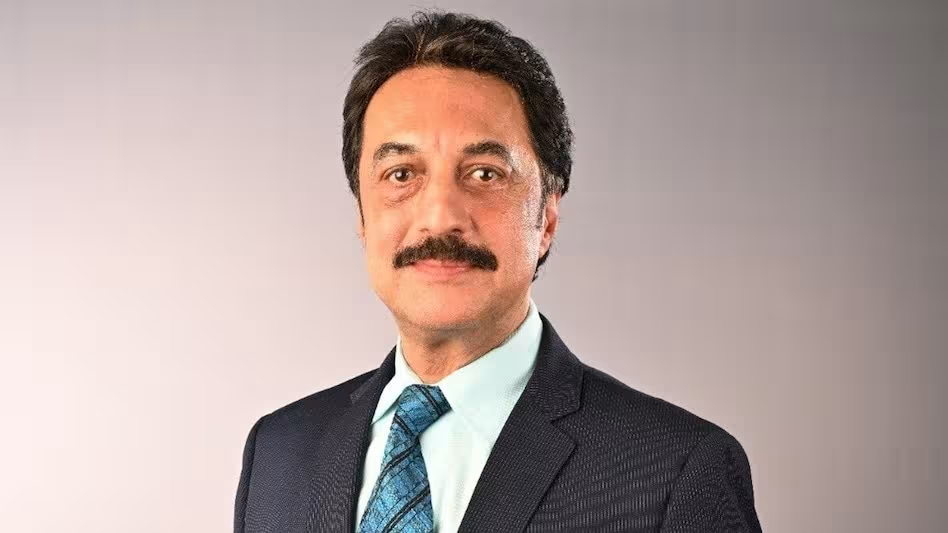
Veteran investor Shankar Sharma has sparked fresh debate over India’s rapidly expanding derivatives market, warning that unchecked speculative activity could distort the country’s financial ecosystem. His remarks, centered on the structure of the Securities Transaction Tax (STT) in futures and options (F&O) trading, highlight concerns that policy incentives may be encouraging short-term gambling over long-term capital formation. Sharma argues that while derivatives serve a legitimate hedging function, excessive retail participation driven by leverage and low transaction barriers risks systemic imbalances. The discussion comes amid record trading volumes in India’s equity derivatives segment and growing regulatory scrutiny over investor protection and market stability.
A Market at an Inflection Point
India’s equity markets have witnessed a dramatic surge in derivatives activity over the past few years. Futures and options volumes now far exceed those in the cash segment, reflecting a structural shift in how participants engage with financial markets. Lower capital requirements, easy digital access, and the allure of quick gains have drawn a wave of first-time traders into leveraged products.
Shankar Sharma, known for his outspoken market commentary and macroeconomic insights, cautions that this trend may be moving beyond healthy financial deepening into the realm of excessive speculation. His central argument is straightforward: capital markets should primarily serve investment, capital formation, and risk management — not resemble betting platforms driven by short-term price swings.
The STT Debate
At the heart of Sharma’s remarks is the structure of the Securities Transaction Tax on futures and options. STT, originally designed to create a transparent tax framework and curb excessive speculation, now plays a complex role in trading behavior. Critics argue that while the tax generates revenue, its design does not necessarily discourage rapid, high-frequency speculation in derivatives.
Sharma’s position suggests that current tax structures, combined with leverage and option premium pricing, may inadvertently make speculative trades appear inexpensive and accessible. This, he implies, distorts risk perception among retail participants who may not fully understand the asymmetric payoff structures and time decay risks embedded in options trading.
Investment vs. Speculation
A key distinction in Sharma’s critique is between productive investment and speculative churn. Long-term investors contribute to capital formation, corporate growth, and economic expansion. In contrast, high-velocity derivatives speculation largely represents zero-sum activity, where gains for one participant mirror losses for another, without directly funding productive enterprise.
From a macroeconomic perspective, an overemphasis on speculative derivatives trading can divert household savings away from long-term wealth creation vehicles such as equities, bonds, and mutual funds. Sharma’s warning that “India cannot become a casino” underscores the need to preserve the integrity and purpose of financial markets as engines of sustainable growth rather than platforms for mass speculation.
Rising Retail Participation
One of the most significant developments in India’s markets is the surge in retail involvement in F&O trading. Technology platforms, social media narratives around quick profits, and low brokerage costs have lowered entry barriers dramatically. However, data trends have repeatedly shown that a large majority of retail derivatives traders incur losses over time.
Sharma’s comments align with broader concerns that inexperienced investors may be underestimating the complexity and risk of leveraged instruments. Options trading, in particular, involves non-linear payoffs, volatility pricing, and time sensitivity — factors that can erode capital rapidly when misunderstood.
Regulatory and Policy Implications
The debate around STT and derivatives speculation arrives as regulators increasingly focus on investor protection, disclosure norms, and risk management frameworks. Policymakers face a delicate balancing act: maintaining market liquidity and innovation while ensuring that financial participation does not morph into systemic vulnerability.
Sharma’s intervention adds to the growing chorus advocating a reassessment of incentives embedded in the trading ecosystem. Potential responses could include tighter margin norms, improved risk disclosures, enhanced financial literacy initiatives, or a restructured tax approach that better aligns with long-term market development goals.
The Bigger Economic Picture
India’s growth story depends heavily on channeling domestic savings into productive assets that fund infrastructure, industry, and entrepreneurship. If speculative derivatives trading absorbs a disproportionate share of household capital, it may weaken this transmission mechanism.
Sharma’s warning is therefore less about opposing derivatives as a financial tool and more about preserving balance. Derivatives markets, when used prudently, improve price discovery and risk hedging. But when speculative participation overwhelms hedging demand, volatility and fragility can increase.
Conclusion
Shankar Sharma’s assertion that India must avoid becoming “a casino” reflects a deeper concern about the direction of financial market evolution. His critique of STT in the futures and options segment serves as a broader call to reassess whether current structures encourage productive investment or speculative excess. As derivatives volumes continue to climb, the conversation he has reignited may shape future regulatory and tax policy decisions aimed at safeguarding both investors and the long-term stability of India’s financial system.
Comments