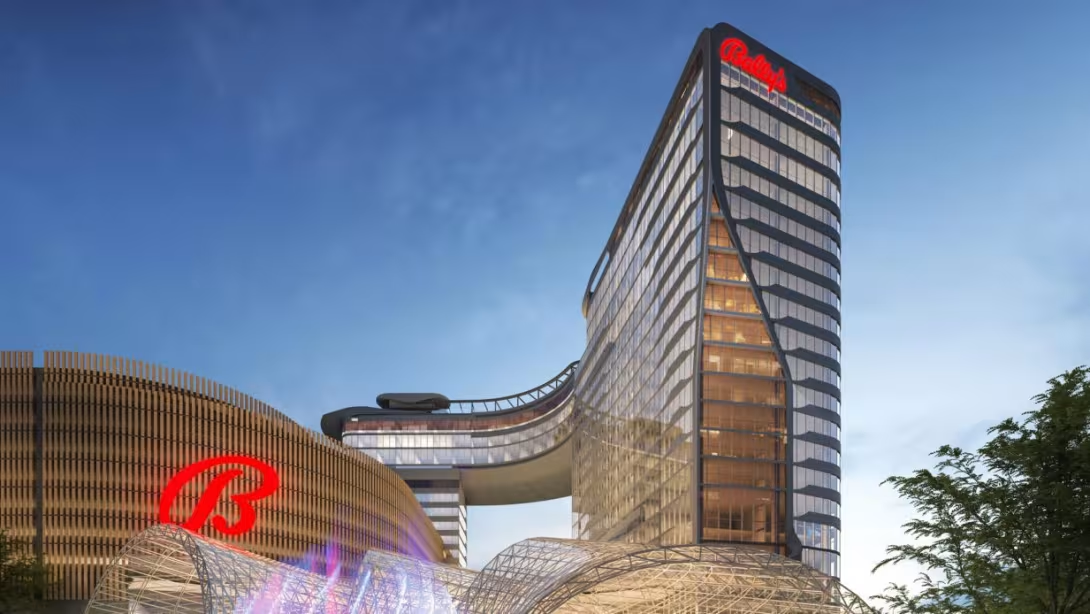
New York State has taken a decisive step in expanding its downstate gaming footprint by awarding three full casino licenses to projects in the Bronx and Queens. After a year-long and highly competitive selection process that narrowed eight proposals to a final slate, regulators approved developments led by some of the world’s most prominent design and architecture firms. Two of the winning projects involve entirely new construction, while the third expands an existing gaming facility near JFK Airport. Together, the developments signal a major shift in urban planning, economic investment, and the future of regulated gaming in New York City.
---
A Competitive and Contentious Selection Process
The licensing decision concludes an intense and closely watched contest among developers seeking access to one of the most lucrative gaming markets in the United States. Over the past year, state authorities evaluated proposals on economic impact, community integration, design quality, and long-term viability.
From an initial pool of eight bidders, three projects ultimately emerged as winners. The outcome reflects a balancing act between economic ambition and urban responsibility, with regulators favoring proposals that combined financial scale with thoughtful design and public-space considerations.
---
The Winning Developments
The three approved casino projects are strategically distributed across two boroughs, underscoring the state’s intent to spread economic benefits beyond Manhattan.
In Queens, Hard Rock Metropolitan Park will be developed by SHoP Architects in collaboration with landscape architecture studio Field Operations. The project envisions a large-scale entertainment destination anchored by a full casino, integrated with expansive public spaces and transit-adjacent infrastructure.
Also in Queens, Resorts World New York City—designed by Perkins Eastman—will expand an existing racino near John F. Kennedy International Airport. Unlike the other approvals, this project builds upon an operational gaming facility, allowing for a faster transition to a full casino model.
In the Bronx, Bally’s Bronx Casino, led by HKS and Gensler, will introduce a major new entertainment complex, marking one of the borough’s most significant private developments in recent years.
---
Ground-Up Construction vs. Expansion
Two of the three projects—Metropolitan Park and Bally’s Bronx Casino—will require complete ground-up construction. These developments are expected to generate substantial construction employment while reshaping large urban parcels that have long been underutilized.
By contrast, the Resorts World expansion benefits from existing infrastructure and a familiar customer base. Its evolution from a racino into a full casino illustrates how regulatory change can rapidly unlock additional value from established assets.
---
Economic and Urban Implications
Beyond gaming revenue, the awarded licenses are expected to drive billions of dollars in private investment, create thousands of permanent jobs, and contribute meaningful tax receipts to state and local budgets. Equally significant is the role of architecture and urban design in these projects, many of which emphasize public parks, transit connectivity, and mixed-use programming.
The involvement of globally recognized design firms signals an ambition to ensure that these casinos function not as isolated venues, but as integrated components of their surrounding neighborhoods.
---
A Turning Point for New York’s Gaming Strategy
The approval of these three casino licenses marks a turning point in New York’s approach to regulated gaming. Rather than incremental expansion, the state has opted for a concentrated, high-impact strategy that ties gaming development to broader urban and economic goals.
As these projects move from planning to construction, their success will be measured not only by gaming revenue, but by how effectively they deliver jobs, revitalize neighborhoods, and coexist with the dense urban fabric of New York City.
Comments