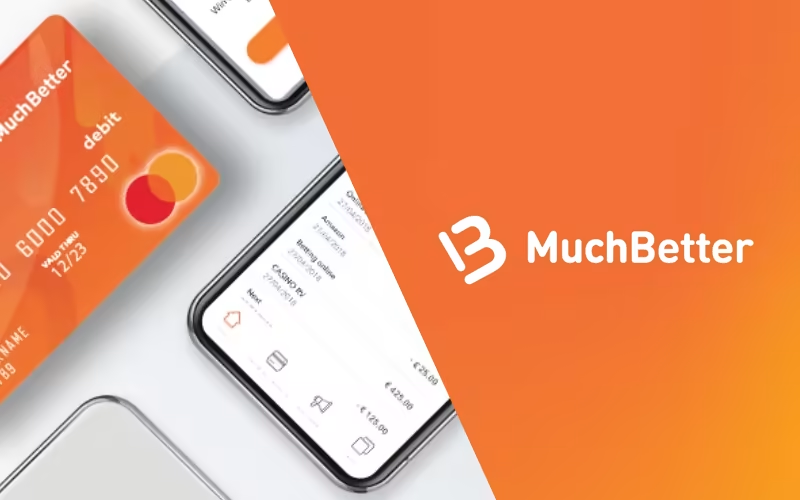
In 2025, MuchBetter has begun emerging as a compelling payment alternative within India’s growing online casino market, prized for its mobile-first model, biometric security features, low fees, and streamlined user experience. Indian players increasingly prefer it for both deposits and withdrawals, leveraging its rapid transaction speeds and absence of cumbersome intermediaries. Yet regulatory ambiguity and the volatility of online gaming laws in India pose challenges to wider adoption. This article dissects MuchBetter’s value proposition, operational mechanics, regulatory context, advantages and limitations, and outlook — offering a rigorous, analytical perspective for informed readers.
India’s Digital Payments Landscape and Gaming Demand
India has experienced a surge in digital payments over the past decade. UPI, mobile wallets, and instant bank transfers have become deeply embedded in everyday commerce. Against this backdrop, the online gaming and casino segment is evolving too, with greater demand for seamless, secure payment methods. MuchBetter, originally designed for gaming-adjacent transactions, is now poised to capture attention in this domain — particularly among users seeking convenience and privacy without compromising on compliance and speed.
Nevertheless, India’s regulatory framework for online gambling remains unsettled. Some states ban gambling, others permit regulated wagering, and the central law is ambiguous. Thus, payment intermediaries that serve casino operators and players must navigate legal uncertainty, anti-money-laundering rules, foreign exchange regimes, and banking restrictions. In that sense, MuchBetter’s ambition faces structural headwinds even as demand grows.
How MuchBetter Works: Architecture and Mechanics
MuchBetter operates as a mobile wallet, supporting deposits, withdrawals, and ancillary payments. Its architecture emphasizes:
- Device Pairing and Authentication: Each account is linked to a mobile device; transactions require approval via that device, often with biometric or PIN controls.
- Integration with Card and Bank Funding: Users can top up the wallet from linked debit/credit cards or bank accounts; from there, they can initiate transfers to casinos or other merchants.
- Low Fee Structure: MuchBetter imposes minimal fees: bank transfers are typically free; use of Visa/MasterCard may incur 0–5 percent; withdrawals and currency conversion draw modest charges.
- Instant or Near-Instant Settlement: For supported merchants (including casinos), deposits credit immediately. Withdrawals back to the wallet may take some hours, subject to the casino’s processing time.
This design minimizes friction, shields players from exposing card or bank credentials to casino operators, and centralizes control within the wallet interface.
Globally, MuchBetter is regulated as an electronic-money institution in the U.K. under the Financial Conduct Authority (FCA). Its reputation for compliance and oversight bolsters trust in markets like India, where regulatory legitimacy is a key differentiator.
Adoption in India: Trends, Metrics, and Use Cases
Casino Platforms Embracing MuchBetter
A growing number of online casinos accessible to Indian players now advertise support for MuchBetter in their cashier sections. These sites typically allow deposits in Indian Rupees (₹), which helps eliminate currency conversion fees at the casino end. Users report that the minimum deposit thresholds vary by casino—from as low as ₹500 to higher amounts based on that site’s policies.
Withdrawals via MuchBetter are less uniformly supported; where they are permitted, processing times typically range from 24 to 72 hours depending on the casino’s internal policies. In many cases, once the casino approves the withdrawal, funds appear almost instantly in the user’s MuchBetter wallet.
Security, Trust, and User Experience
Players gravitate toward MuchBetter for its layered security: device binding, biometric or PIN validation, and two-factor authentication (2FA). These safeguards reduce fraud exposures, especially in the high-risk gaming payments domain.
From a user experience standpoint, MuchBetter’s mobile-first interface and clear transaction prompts streamline deposit flows. No need to re-enter banking credentials on gambling sites, and the wallet acts as a buffer between casino and bank systems.
Cost Efficiency and Conversion
Because many casinos accept local currency (INR) through MuchBetter, users may avoid hidden currency conversion fees. Meanwhile, MuchBetter’s own fee schedule is competitive: free or negligible for bank transfers, modest charges for card funding, and minimal currency conversion markups. This cost profile helps improve net returns from wagering and reduces friction at the monetary interface.
Challenges, Risks & Regulatory Crosswinds
Legal Ambiguity Around Online Gaming
India lacks uniform federal regulation for online casino gambling. Some states explicitly prohibit, others permit regulated betting, and the central statutes are opaque. Thus, MuchBetter’s casino integrations operate in judicial gray zones. This regulatory uncertainty deters banks and compliance officers from facilitating such transactions, introducing counterparty risk to payment providers.
Banking and Payment Intermediary Risk
Indian banks and financial regulators may scrutinize transactions tied to gambling. In certain instances, banks may classify casinos as high-risk, subject to closure or blocking of payment rails. MuchBetter must maintain robust compliance, anti-money-laundering (AML) controls, and clear justifications for transaction flows to avoid sanctions or blacklisting within India’s financial system.
Withdrawal Bottlenecks and Casino Policies
Even if MuchBetter supports withdrawals, casinos hold the power to delay or scrutinize funds, especially large wins. Some operators may limit the use of MuchBetter only to deposits (forcing alternate routes for payouts), which undermines the closed-loop convenience. Players must remain vigilant to terms and conditions.
Adoption and Liquidity
For widespread adoption, both casinos and users must see mutually reinforcing value. If only a subset of top casinos adopt MuchBetter, user uptake will be constrained. Similarly, user hesitation or low liquidity may discourage smaller operators from incorporating the wallet, creating a chicken-and-egg adoption challenge.
Strategic Outlook: Where MuchBetter Could Lead — and What Might Stall It
Path to Deeper Penetration
If MuchBetter deepens partnerships with credible casino operators and markets itself as a trusted, gaming-friendly wallet, it may attract a loyal niche of users. Its compliance credentials and global regulatory posture can help it gain legitimacy in jurisdictions where gaming is legal but payments are constrained.
Further, the wallet might expand into adjacent services—staking, gaming rewards, loyalty ecosystems—to embed itself in the behavioral ecosystem of Indian players. That hybrids payments + rewards model could cement it as more than a transactional conduit.
Potential Barriers to Growth
However, growth will be limited unless regulatory certainty improves. State-level litigation or bans could unravel progress. Banking pressure—if many banks refuse to process MuchBetter’s payments for casinos—could surgically sever its Indian path.
Moreover, if users face withdrawal friction, delays, or fraud, reputation damage may sharply slow adoption. And competitive pressures from alternative wallets or payment systems integrated more deeply into local finance systems could erode MuchBetter’s niche.
Conclusion
MuchBetter is carving a promising but precarious niche in India’s online casino payments landscape in 2025. Its mobile-centric design, security architecture, favorable cost structure, and user experience advantages distinguish it among payment options. Yet its trajectory hinges on navigating India’s complex regulatory terrain, securing robust banking relationships, and delivering reliable withdrawal experiences.
Comments