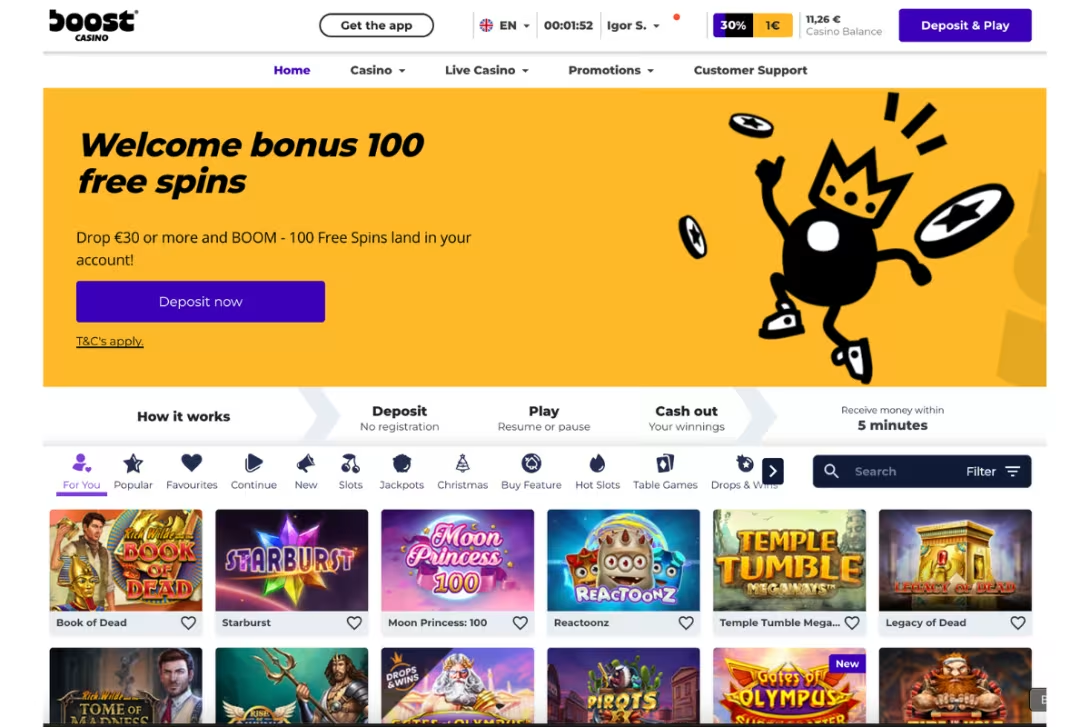
The integration of artificial intelligence into digital gaming platforms is rapidly reshaping the online casino industry. Boost Casino recently partnered with ZingBrain AI to introduce advanced personalization features aimed at improving player engagement, operational efficiency and key financial performance metrics. The collaboration replaced a static, manually curated game lobby with a dynamic, data-driven interface that adapts to individual player behavior. Through a controlled A/B testing framework, the companies observed measurable improvements in turnover, gross gaming revenue per player and game discovery rates. The results highlight how AI-powered recommendation engines are becoming central to modern gaming platforms seeking stronger retention and sustainable growth.
Personalization Emerges as a Strategic Imperative
The online casino sector has entered a new phase where data-driven personalization is increasingly viewed as a critical component of long-term growth. Operators are moving beyond traditional game lobbies that display uniform content to every player and are instead adopting intelligent systems capable of adapting in real time to user preferences.
Boost Casino’s collaboration with ZingBrain AI represents a practical example of this shift. The project was designed to replace a manually maintained lobby structure with an adaptive environment capable of presenting highly relevant gaming options to each individual user.
From a strategic standpoint, the objective extended beyond improving user experience. The initiative was also intended to strengthen core commercial metrics such as player retention, engagement frequency and overall gaming revenue.
From Static Layouts to Intelligent Recommendations
Before the introduction of artificial intelligence, the casino platform relied on a single method of organizing games across its digital lobby. While functional, this approach offered limited flexibility in tailoring the experience to the diverse preferences of individual players.
The integration of ZingBrain’s technology introduced a more sophisticated architecture that dynamically generates personalized game recommendations. This transformation was achieved without disrupting the platform’s established user interface, ensuring that the transition remained seamless for existing customers.
The system’s design carefully balanced visibility and usability. Personalized modules were placed in prominent areas within the lobby, allowing players to discover new content while maintaining the familiar structure of the original layout.
A/B Testing Validates the Impact
To determine whether the personalization features delivered measurable value, the companies implemented a structured A/B testing framework. One group of users continued to interact with the traditional casino lobby, while another group experienced the newly personalized environment.
This controlled approach allowed analysts to isolate the impact of artificial intelligence on player behavior. By comparing the two groups, researchers were able to evaluate changes in engagement patterns and financial outcomes without interference from external variables.
The results demonstrated a clear improvement in key performance indicators. Both turnover and gross gaming revenue per player recorded measurable gains within the group exposed to personalized recommendations.
Additionally, analysts tracked a secondary metric: the number of unique games played by each participant. This figure also increased modestly, indicating that players were exploring a broader range of titles than before.
Two Core Personalization Features
The system introduced two primary recommendation mechanisms designed to guide players toward relevant content.
The first module appears directly on the main casino page as a personalized recommendation section. This feature combines familiar titles that a player already enjoys with new games that align with their behavioral patterns.
At the center of this system is a proprietary measurement known as the Discovery Score. The algorithm calculates how likely a player is to experiment with unfamiliar titles and adjusts recommendations accordingly. Users who frequently try new games receive a larger proportion of fresh suggestions, while more conservative players see a greater number of familiar options.
The second feature activates when a player exits a game. Before returning to the lobby, the system displays a pop-up window presenting similar titles that match the characteristics of the recently played game.
These recommendations are generated using multiple parameters, including game type, thematic elements, volatility profiles, gameplay mechanics and collaborative behavioral signals derived from other users with similar preferences.
Data Science Behind the Performance Gains
Evaluating the success of personalization required sophisticated analytical techniques. Financial indicators such as turnover and gross gaming revenue can fluctuate due to seasonality, marketing campaigns and broader traffic trends.
To address this challenge, analysts used several statistical methodologies to isolate the true impact of the AI integration. These included percentile-based segmentation, median value analysis for long-term users and the application of the CUPED method, a technique commonly used in experimental design to reduce variance.
Statistical significance was also assessed through p-value calculations to confirm that the improvements observed during testing were not the result of random variation.
The findings indicated that the uplift in key financial metrics was both statistically meaningful and operationally sustainable.
Strengthening Player Engagement
One of the most notable long-term outcomes was the increasing reliance on recommendation modules as the primary method of game discovery. Over time, a growing share of players began selecting titles directly from personalized suggestions rather than browsing the broader game catalog.
This shift reflects a broader transformation across digital entertainment platforms. As content libraries expand into the thousands of titles, intelligent discovery tools become essential for guiding users toward experiences that match their preferences.
For casino operators, improved discovery mechanisms can translate directly into higher engagement levels and longer playing sessions.
Operational Efficiency and Reduced Manual Work
Beyond improving player engagement, the AI integration also delivered operational advantages. Traditionally, maintaining a casino lobby requires continuous manual adjustments by product teams responsible for highlighting featured games and updating promotional sections.
The introduction of automated recommendation systems significantly reduced this workload. Once implemented, the algorithms continuously analyze player behavior and update recommendations without requiring constant human intervention.
This automation enables product teams to focus on broader strategic initiatives rather than routine content management.
Industry Implications
The success of this collaboration underscores the growing importance of artificial intelligence within the global online gaming industry. As competition intensifies, operators are increasingly investing in technologies that enable deeper personalization and real-time behavioral analysis.
Industry observers suggest that recommendation engines will soon become a standard component of most digital gaming platforms. Similar systems are already widely used in streaming media, e-commerce and social networks, where personalized content has proven highly effective at increasing user engagement.
For the casino sector, adopting such technologies represents a natural progression toward more sophisticated digital ecosystems.
Future Expansion of AI Personalization
Following the positive outcomes of the initial implementation, the two organizations plan to expand personalization across additional areas of the platform. Future developments are expected to incorporate more advanced behavioral signals and real-time analytics capable of adapting recommendations instantly as players interact with games.
Further experimentation may also explore deeper discovery scenarios, allowing players to uncover niche titles that align closely with their preferences.
These enhancements aim to create a continuously evolving gaming environment where the platform adapts dynamically to each individual user.
The Future of Player-Centric Casino Platforms
The collaboration between Boost Casino and ZingBrain AI demonstrates how advanced analytics and machine learning can reshape digital entertainment experiences. By combining sophisticated algorithms with thoughtful user experience design, operators can deliver more relevant content while simultaneously improving financial performance.
As artificial intelligence continues to mature, personalization is likely to become one of the defining competitive advantages within the online gaming market. Platforms capable of understanding player behavior at a granular level will be best positioned to capture long-term loyalty and sustainable growth.
In an increasingly data-driven industry, the shift toward intelligent, player-centric design may prove to be one of the most important developments shaping the future of digital gaming.
Comments